
Selling a U.S. property as a Canadian involves more than listing the home, accepting an offer, and attending closing. In many cases, the transaction also triggers the Foreign Investment in Real Property Tax Act, commonly called FIRPTA.
FIRPTA requires the buyer or closing agent to withhold money from the proceeds when a foreign person sells U.S. real estate. For Canadian sellers, the standard withholding can be 15% of the gross sale price, even when the seller’s actual taxable gain is substantially lower: or when the seller has no taxable profit at all.
This guide explains FIRPTA for Canadians, including withholding rates, residence exceptions, tax returns, ITINs, IRS forms, refunds, Canadian reporting, and practical steps to take before listing a U.S. property.
Important general-information disclaimer: This article is educational and does not provide legal, tax, accounting, or investment advice. FIRPTA rules, federal tax rates, state requirements, Canadian reporting obligations, and IRS processing procedures can change. Obtain current advice from qualified U.S. and Canadian cross-border tax professionals before selling U.S. real estate.
What Is FIRPTA and Why Does It Apply to Canadians?
FIRPTA is a U.S. tax law designed to ensure that foreign owners pay any U.S. tax due when they sell an interest in U.S. real property.
For U.S. tax purposes, a Canadian who is not a U.S. tax resident is generally treated as a foreign seller. This can include:
- Canadian snowbirds selling a Florida or Arizona vacation home
- Canadians selling a U.S. rental property
- Canadian investors disposing of U.S. real estate
- Canadians who previously lived in the United States but are now nonresidents
- Estates, trusts, or entities with foreign ownership interests
The important distinction is that FIRPTA withholding is generally based on the gross amount realized, not on the seller’s net profit.
FIRPTA Withholding Is Not the Final Tax Bill
The most common misunderstanding about FIRPTA for Canadians is confusing withholding with final tax liability.
FIRPTA withholding is an advance payment collected at closing. The final U.S. tax is calculated later on the seller’s U.S. tax return. The final calculation considers items such as:
- Adjusted basis
- Capital improvements
- Selling expenses
- Depreciation
- Holding period
- Taxable income
- Filing status
- Applicable federal and state rules
If the IRS receives more than the seller ultimately owes, the excess may be refundable after the seller files the appropriate U.S. return. If the withholding is insufficient, the seller may owe an additional balance.
In practical terms, FIRPTA is a cash-flow issue at closing, while the final tax liability is determined through tax reporting.
General FIRPTA Withholding Rates for Canadian Sellers
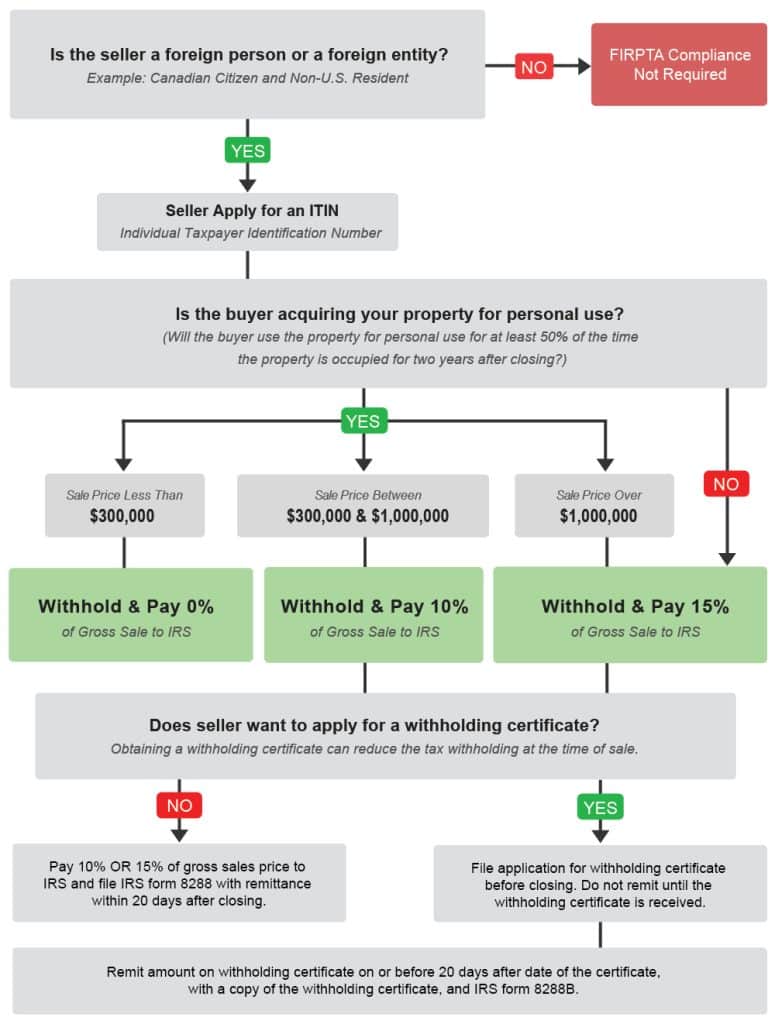
The standard rule is generally 15% of the gross sale price.
These thresholds are not automatic exemptions. The applicable rate depends on the purchase price, the buyer’s intended use, the buyer’s representations, and the documentation accepted by the closing parties.
The $300,000 Residence Exception
Withholding may be reduced to 0% when:
- The sale price is below $300,000; and
- The buyer intends to use the property as a residence under the applicable FIRPTA requirements.
Generally, the buyer must have a genuine intention to use the property as a residence and satisfy the required use test. A buyer’s written residence representation or affidavit may be required at closing.
The $300,000 to $1,000,000 Residence Rate
When the sale price falls within the $300,000–$1,000,000 range and the buyer meets the residence-use requirements, the withholding rate may be reduced to 10%.
For example, on an $800,000 sale:
- Standard 15% withholding: $120,000
- Potential residence-based 10% withholding: $80,000
The buyer’s intended use and proper documentation are essential. A property purchased strictly as a rental or investment generally will not qualify for the residence-based reduction.
Sales Above $1,000,000
For sales above $1,000,000, the general FIRPTA withholding rate is 15%, even if the buyer plans to occupy the property as a residence.
For a $1,500,000 sale, 15% withholding would equal $225,000 before considering any approved withholding certificate or other applicable exception.
Why Gross-Sale-Price Withholding Can Exceed the Actual Tax
Consider this simplified example:
- Original purchase price: $400,000
- Capital improvements: $100,000
- Selling expenses: $40,000
- Sale price: $600,000
- Estimated economic gain after basis and selling expenses: approximately $60,000
- FIRPTA withholding at 15% of gross sale price: $90,000
The $90,000 withholding is calculated from the gross sale price, not the estimated $60,000 gain. Depending on the seller’s full tax circumstances, the final U.S. federal tax could be significantly less than the amount withheld.
The seller may recover the difference by filing a U.S. tax return and claiming credit for the FIRPTA withholding. However, the funds may remain unavailable until the return is prepared, filed, processed, and any refund is issued.
Adjusted Basis, Improvements, Expenses, and Depreciation
A proper estimate requires more than the original purchase price.
Adjusted basis
Adjusted basis may begin with the purchase price and may include qualifying acquisition costs and capital improvements. It can be reduced by items such as depreciation.
Potentially relevant records include:
- Closing statement from the purchase
- Major renovations
- New roof, HVAC, windows, or additions
- Structural improvements
- Legal or professional acquisition costs
- Depreciation claimed or allowable
- Closing costs from the sale
- Real estate commissions
- Repairs that qualify as selling expenses
Routine maintenance is generally treated differently from capital improvements. Keep invoices, receipts, permits, and contractor records.
Depreciation recapture
If the property was rented, depreciation may have reduced the property’s tax basis. Depreciation recapture or related rules can affect the final tax calculation, even if the seller did not claim every available depreciation deduction.
Holding period
A property held for more than one year may qualify for long-term capital-gain treatment under applicable U.S. rules. The final result depends on the seller’s complete tax profile, property use, depreciation, income, and other factors.
Selling at a loss
A loss does not necessarily prevent FIRPTA withholding. The withholding calculation is generally tied to the gross transaction amount. A seller may therefore have money withheld even when the final tax return shows little or no taxable gain.
The FIRPTA Process for Canadians
1. Pre-listing consultation
Before listing, review the expected sale price, purchase documents, ownership structure, property use, improvements, depreciation, and anticipated selling costs with a cross-border professional.
This is the stage to identify whether withholding may exceed the final tax and whether a withholding certificate should be considered.
2. Confirm or obtain an ITIN
A Canadian seller generally needs an Individual Taxpayer Identification Number, or ITIN, for U.S. tax reporting.
An ITIN helps the IRS connect:
- FIRPTA withholding
- Form 8288-A
- The seller’s Form 1040-NR
- Any potential refund
Obtaining an ITIN can take time. Sellers should confirm whether they already have a valid number and begin the application process early when necessary. Supporting identification, such as a properly certified passport copy, may be required.
3. List and sell the property
Once the tax and closing strategy is reviewed, the property can be listed. The listing agent, tax professional, and title or escrow company should understand that the seller is Canadian and may be subject to FIRPTA. Always hire an agent who specializes in working with Canadians and has a deep understanding of FIRPTA to ensure no issues arise. We have experienced agents across the country.
4. Closing and withholding
In many U.S. states, a title company or escrow company coordinates the closing. The buyer or settlement agent generally acts as the withholding agent.
At closing, the settlement team may:
- Determine the applicable withholding rate
- Collect the required amount from the seller’s proceeds
- Prepare withholding documentation
- Remit the funds to the IRS
- Coordinate with the seller’s tax professionals
The source Canada to USA FIRPTA guidance states that withholding is generally remitted to the IRS within 20 days of closing. Confirm current filing and remittance requirements with the closing agent and qualified tax professional.
5. IRS remittance and Form 8288
Form 8288, U.S. Withholding Tax Return for Dispositions by Foreign Persons of U.S. Real Property Interests, is generally filed by the withholding agent with the withheld funds.
6. Form 8288-A
Form 8288-A, Statement of Withholding, identifies the amount withheld for the foreign seller. The seller typically needs the IRS-processed form to claim the withholding as a credit on the U.S. tax return.
Keep all closing documents and follow up if the form is delayed or contains incorrect information.
7. Form 8288-B withholding certificate
Form 8288-B is an application for a withholding certificate. It may be considered when the seller expects the actual U.S. tax to be lower than the standard FIRPTA withholding.
Potential reasons include:
- A relatively small taxable gain
- Significant documented improvements
- High selling expenses
- A potential loss
- Depreciation and basis adjustments
- A tax calculation showing that 15% of the gross price is excessive
The application should generally be prepared and filed before closing. IRS processing can take months, and processing may take approximately six to eight months in some circumstances. Timing is therefore critical.
Depending on the circumstances, funds may be held by the closing parties while the application is pending, or the standard withholding may occur and be recovered later through the tax return process. The exact procedure must be coordinated with the title or escrow company and tax professional.

Filing the U.S. Tax Return
A Canadian seller generally files a U.S. federal nonresident tax return, commonly Form 1040-NR, for the year of the sale.
The return reports the disposition and calculates the final U.S. tax. The seller may claim credit for FIRPTA withholding shown on the applicable Form 8288-A.
The result may be:
- A refund when withholding exceeded final tax
- No additional payment when withholding matched the tax
- A balance owing when withholding was insufficient
Your refund may be forfeited if a return is not filed within three years of the sale. Because deadlines and IRS procedures can change, confirm the current filing and refund rules with a qualified professional.
State, Canadian, and Currency Considerations
Federal FIRPTA is only one part of the analysis.
State tax
Some states require a separate income tax return or withholding process. The requirements depend on the property’s location, seller status, state income, and transaction details.
Canadian reporting
The sale may also need to be reported in Canada. Canadian residents should discuss:
- Reporting the disposition on their Canadian return
- Foreign property reporting requirements
- Whether the property was personal-use or income-producing
- Foreign-tax-credit coordination
- The Canada–U.S. tax treaty
- Exchange-rate conversion for purchase, expenses, sale proceeds, and taxes
Currency fluctuations can affect the Canadian-dollar gain even when the U.S.-dollar calculation appears straightforward. Maintain records showing the exchange rates and dates used.
Common FIRPTA Mistakes
Avoid these frequent problems:
- Waiting until closing to ask about FIRPTA
- Hiring a Realtor with no knowledge of FIRPTA
- Assuming 15% withholding is the final tax
- Using a general CPA without FIRPTA experience
- Failing to document capital improvements
- Overlooking depreciation recapture
- Assuming a loss automatically eliminates withholding
- Relying on the buyer’s residence exception without documentation
- Ignoring state filing requirements
- Delaying an ITIN application
- Forgetting Canadian reporting
- Failing to follow up on Form 8288-A
- Applying for Form 8288-B too close to closing
Practical Pre-Sale Checklist
Six to twelve months before listing
- Confirm whether you are a U.S. tax resident or foreign seller
- Locate your ITIN or begin an application
- Gather the original purchase closing statement
- Collect improvement invoices and permits
- Review rental history and depreciation
- Estimate selling costs and expected price
- Consult a cross-border tax professional
One to three months before closing
- Estimate standard FIRPTA withholding
- Review whether a residence-based rate could apply
- Determine whether Form 8288-B is appropriate
- Coordinate with the title or escrow company
- Confirm ownership and seller information
- Review state and Canadian filing considerations
- Plan for currency conversion of sale proceeds
At and after closing
- Confirm the withholding amount
- Obtain copies of closing documents
- Confirm Forms 8288 and 8288-A are handled correctly
- Retain proof of IRS remittance
- File the required U.S. tax return
- Claim the FIRPTA withholding credit
- Complete Canadian reporting
- Track any refund or balance owing
Canada to USA FIRPTA Support for Canadian Sellers
Canada to USA provides an online FIRPTA calculator and information resource for Canadians. The calculator can help estimate potential withholding and tax considerations, but it is an estimate: not a tax assessment or substitute for professional advice.
When a Canadian sells a U.S. property using the Canada to USA real estate team, Canada to USA processes and files the FIRPTA paperwork and U.S. tax returns at no cost as a Canada to USA service benefit. Applicable taxes, IRS charges, third-party costs, and individualized legal, tax, or accounting advice may still apply where relevant.
The team also coordinates specialized cross-border real estate and tax professionals, including agents who understand the specific needs of Canadian sellers.
Contact Canada to USA Before Selling
FIRPTA planning should begin before the property is listed: not on the day of closing.
Contact Canada to USA for assistance with selling U.S. real estate as a Canadian:
- Phone: 1-844-226-8629
- Email: info@canadatousa.com
- FIRPTA information and online calculator
Canada to USA can connect you with specialized agents serving Canadians, coordinate the FIRPTA process, and help you access the team’s exclusive discounted currency exchange rates when transferring U.S. sale proceeds to Canada.